Once mathematical analysis and linear algebra formally began, the pace of study changed immediately. I am still following the algebra lectures as they move forward, but analysis already feels as though I am listening to a foreign language. I can follow several symbols during class, then look back and realise that the relationships among the definitions never properly connected.
This afternoon in the library, I reviewed my notes around three related topics: Dedekind cuts, Cauchy sequences, and the Archimedean property. Each addresses the same underlying question—how the “gaps” in the rational numbers can be filled to obtain the complete real number system.

Dedekind cuts: representing a boundary with a set
I had originally understood Dedekind's method as a process of “tightening indefinitely,” but that picture is closer to the Cauchy-sequence construction. A Dedekind cut does not begin with a sequence gradually approaching a target. Instead, it divides all rational numbers directly into a lower and an upper class.
If we keep only the lower class A, it must satisfy several conditions: A is nonempty and not all of Q; whenever x ∈ A and y < x, we also have y ∈ A; and A has no greatest element. Intuitively, A contains every rational number to the left of some boundary. Even when the boundary is irrational, such as √2, the set {q ∈ Q | q < √2} can still be described entirely within the rationals.
A real number can therefore be represented by such a lower class. Comparisons between real numbers become inclusion relations between their lower classes. The statement on the blackboard, r₁ < r₂ ⇔ A(r₁) ⊊ A(r₂), translates order on the number line into a relation between sets.
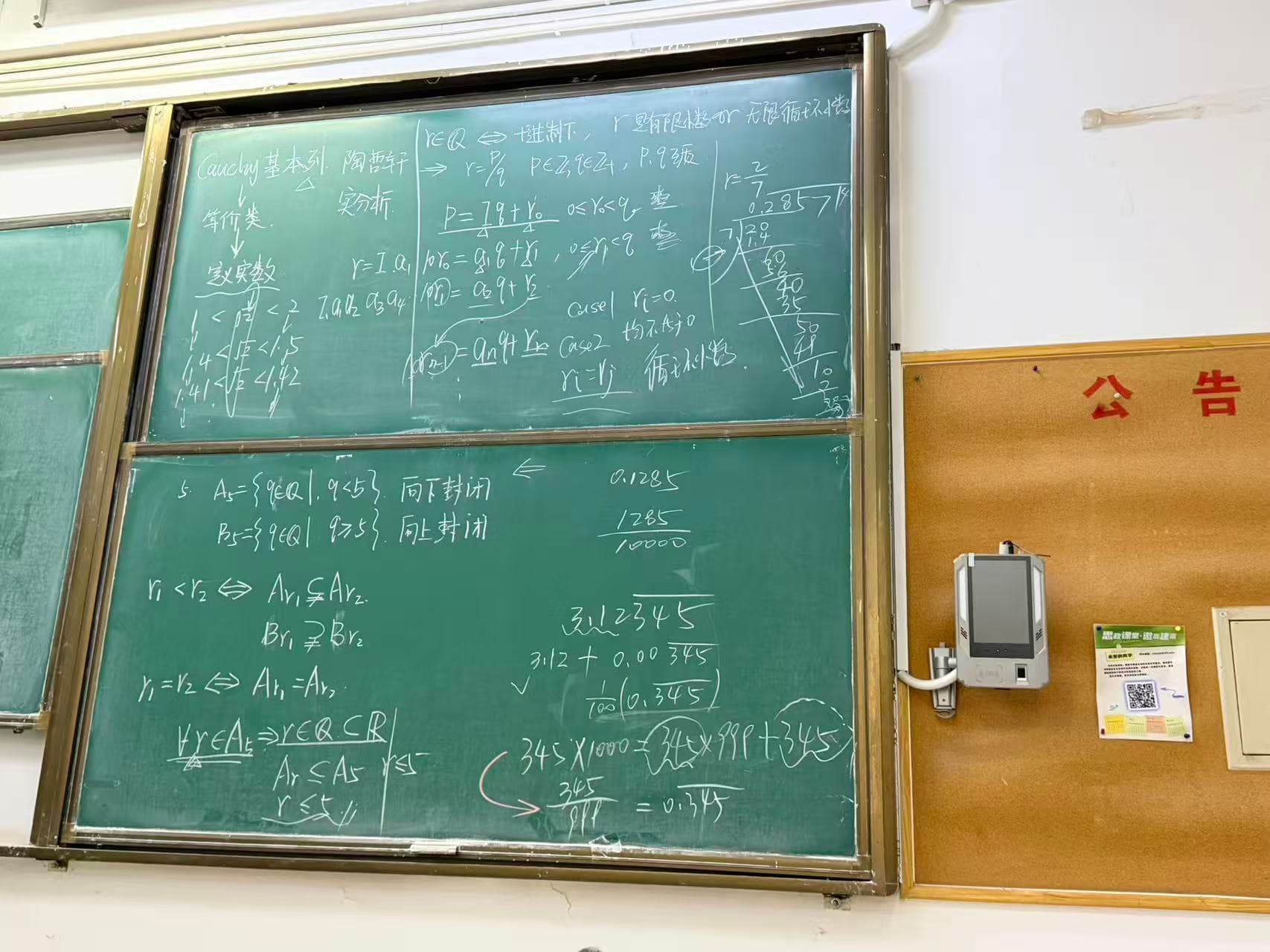
Cauchy sequences: grouping processes that approach the same result
The Cauchy construction starts elsewhere. Instead of describing a boundary with a set, it asks whether the terms of a rational sequence eventually become arbitrarily close to one another.
A rational sequence (aₙ) is Cauchy when, for every ε > 0, there exists N such that |aₘ-aₙ| < ε whenever m,n > N. The definition does not need to name the limit in advance. It only checks whether sufficiently late terms are close to each other.
Treating every Cauchy sequence as a different real number would create too many numbers, because distinct sequences can approach the same result. A sequence of decimal truncations and a sequence of fractional approximations might both tend towards √2. We therefore introduce an equivalence relation: (aₙ) and (bₙ) are equivalent when aₙ-bₙ → 0. A real number is represented not by one privileged sequence but by an entire equivalence class.
I can now begin to see the common idea. Dedekind encodes “the same boundary” as a lower class; the Cauchy construction encodes “the same limiting value” as an equivalence class. Their forms differ, but both fill in limits that are missing from the rationals.
The Archimedean property: 1/n reaches every positive scale
One statement of the Archimedean property is that, for every pair of positive real numbers x,y, there exists a natural number n such that nx > y. Equivalently, the natural numbers are not bounded above in the reals.
A form used more often in analysis says that, for every ε > 0, there exists a natural number n such that 1/n < ε.
The point I need to keep straight is that 1/n is always positive. It never becomes zero, yet as n grows it becomes smaller than any positive scale chosen in advance. It is not “equal to an infinitesimal”; it can be made arbitrarily close to zero. That is what allows an error term to be pushed below every prescribed tolerance in a limit argument.
The blackboard also contained a useful proposition: if a < b + ε for every ε > 0, then a ≤ b. A proof by contradiction is short. If a > b, choose ε = (a-b)/2 > 0. Then
b + ε = (a+b)/2 < a,
contradicting a < b + ε. Therefore a ≤ b. This proposition does not itself require the Archimedean property, but both ideas require me to understand exactly what “for every positive ε” means. I used to read “arbitrarily small error” as an intuitive phrase; I am only beginning to see how it can do precise work inside a proof.

ε, the error condition can force an exact order relation.What has not connected yet
At this point I can restate the three ideas separately, but I cannot claim to have mastered them. I still need to understand why the absence of a greatest element is indispensable in a Dedekind lower class, why addition and multiplication of Cauchy equivalence classes do not depend on the chosen representatives, and how the two constructions correspond rigorously.
For the next review, I want to do two concrete things: rewrite the definitions of a lower class and a Cauchy sequence without looking at the textbook, then reproduce the proof of ∀ε>0, a<b+ε ⇒ a≤b in full. The definitions need to become stable before I move further into completeness.
Comments
0 comments