After class today, I put the blackboard notes beside my earlier questions about constructing the real numbers and tried to organize them as one line of thought. When I looked at the definitions separately, they felt like unrelated pieces of notation. Seen together, they all concern the same issue: why the real line has no gaps, and how “getting arbitrarily close” becomes a statement that can be proved.

Starting from Dedekind lower sets
Dedekind's idea is not to find an irrational number first and then inspect nearby rationals. It reverses the order: the collection of all rationals to the left of a boundary is used to represent that boundary.
A Dedekind lower set A is a nonempty proper subset of Q. It is downward closed: if a ∈ A and b < a, then b ∈ A; it also has no greatest element. The lower set is a whole set, not one number inside it, but in this construction the set as a whole is treated as a real number.
For example, a lower set representing √2 can be written as A = {q ∈ Q | q < 0 or q² < 2}. The condition q < 0 is needed because every negative rational lies to the left of √2. If I wrote only q² < 2, a number such as −2 would be incorrectly excluded because its square is greater than 2.
This corrected one of my earlier confusions. The claim is not that an element of the lower set equals √2; the entire lower set represents √2. To show that it is a legitimate lower set, I still have to verify that it is nonempty, not all of Q, downward closed, and without a greatest element. A picture on the number line is not enough by itself.
Decimal notation is also a form of approximation
The lecture then used the integer and fractional parts. Let [x] be the greatest integer not exceeding x. Then x = [x] + {x}, where 0 ≤ {x} < 1. Negative numbers are the easy place to make a mistake: [−1.7] = −2, so −1.7 = −2 + 0.3.
Repeating decimals can also be converted back into fractions. If y = 0.345345…, the repeating block has three digits, so 1000y − y = 345 and hence y = 345/999. Decimal expansions are therefore not merely informal approximations. Terminating and repeating decimals correspond exactly to rational numbers, while nonrepeating infinite decimals require the completeness of the real numbers.
From the Archimedean property to density of the rationals
One useful form of the Archimedean property says that for every ε > 0, there is a natural number n such that 1/n < ε. The point is not that 1/n becomes zero. Rather, the spacing 1/n can be made finer than any positive length chosen in advance.
Suppose a < b. To find a rational number between them, first choose n large enough that 1/n < b − a. Then take the integer k = [na]. This gives
k/n ≤ a < (k+1)/n.
Set r = (k+1)/n. The left inequality already gives a < r. For the other side,
(k+1)/n = k/n + 1/n ≤ a + 1/n < b.
Therefore a < r < b. The step (k+1)/n < b, which originally stopped me, is not an isolated trick. It works because n was chosen at the beginning to make 1/n < b − a. This proves that a rational number lies between any two distinct real numbers.
Maximum, upper bound, and supremum
A maximum must belong to the set. An upper bound only has to lie above every element, so it need not belong to the set, and a set may have many upper bounds. The supremum sup S is the least of them.
For example, S = (0,1) has no maximum: after every x < 1, there is another element of the set that is larger. It does, however, have supremum 1. In epsilon language, β = sup S means two things:
x ≤ βfor everyx ∈ S, soβis an upper bound;- for every
ε > 0, there is anx₀ ∈ Ssuch thatβ − ε < x₀ ≤ β.
The second statement says that elements of the set approach β arbitrarily closely from the left. If the ceiling were lowered to β − ε, some x₀ would cross it. Thus no smaller number can still be an upper bound.
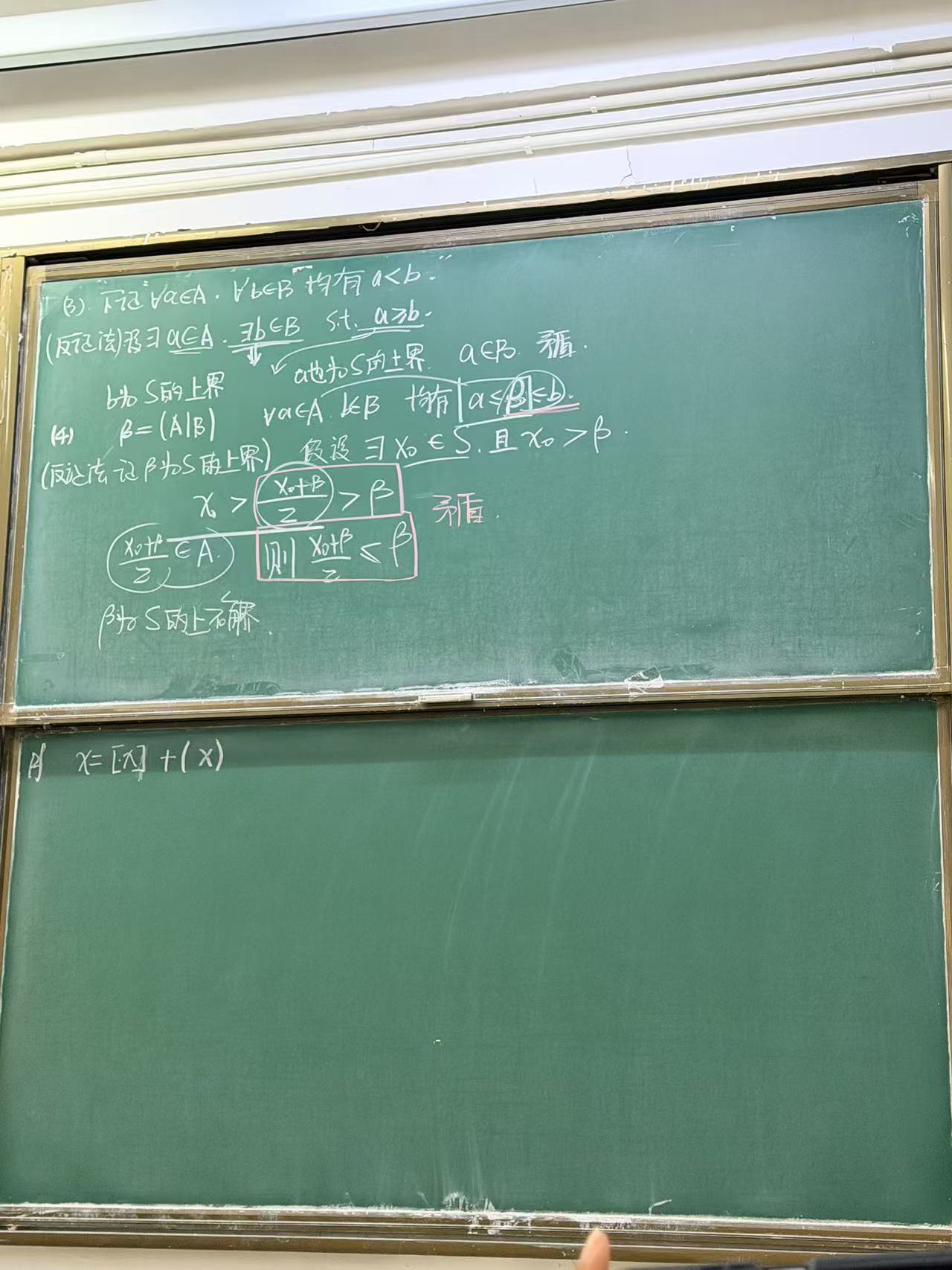
A and all upper bounds into B. Their boundary is the least upper bound we are looking for.Two ways to understand the supremum principle
The supremum principle says that every nonempty set of real numbers that is bounded above has a supremum. The first route on the board lets B be the set of all upper bounds of S and sets A = R \ B. If a ∈ A and b ∈ B, then a < b; otherwise a ≥ b would make a an upper bound as well, contradicting a ∈ A. Completeness gives a boundary point β. One then proves that β is an upper bound and is no larger than any other upper bound, so β = sup S.
The second route is more concrete. Starting with the integer part, choose the largest decimal digit that can occur at each successive place among the remaining elements of the set. This constructs β = β₀.β₁β₂…. If an element x₀ agrees with β through the first n decimal places, then 0 ≤ β − x₀ ≤ 10⁻ⁿ. Given ε > 0, choose n so that 10⁻ⁿ < ε; then x₀ > β − ε, which is exactly the approximation condition for a supremum.
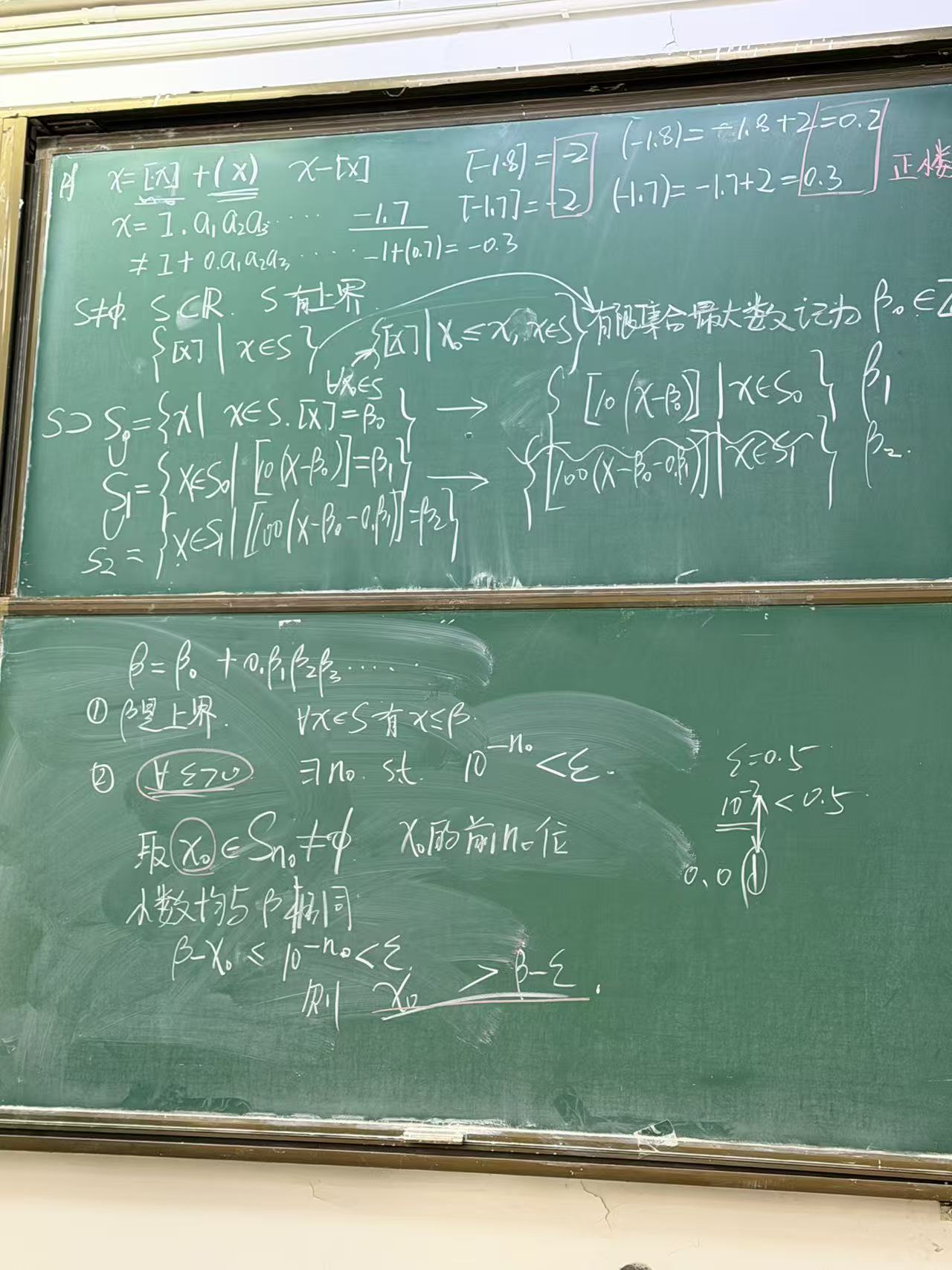
I can now tentatively summarize the main line as follows: Dedekind lower sets fill the gaps in the rationals, the Archimedean property controls arbitrarily fine scales, and the supremum principle expresses the completeness of the resulting real line. I still need to check the strict proof that the lower set for √2 has no greatest element, as well as the double representation behind 0.999… = 1 in the decimal construction.
For my next review, I plan to rewrite the proof of density of the rationals and the epsilon characterization of a supremum without looking at the board. The immediate goal is to explain where every inequality comes from before moving on to limits of sequences.
Comments
0 comments