These notes cover some of my studying in the first half of August: basic Python syntax and the opening sections of Understanding Analysis, including real numbers, irrationality, and methods of proof. A two-week trip interrupted that routine. When I returned, some ideas that had felt familiar were already harder to recall. This is a record of where I am, including those gaps.

Python: making the basics dependable
During this period, I worked through examples involving:
- Naming and using variables;
- Basic arithmetic in Python;
- Comments that explain what code is intended to do;
- Evaluating expressions in an interactive session;
- Simple programs that accept input and produce output;
- Dictionaries and the relationship between keys and values;
- Repeated operations with
forandwhileloops.
My understanding is still at an early stage. I can follow examples, but that does not yet tell me whether I can use the same ideas independently in an unfamiliar problem. The break made this distinction more noticeable: without practice, familiarity fades surprisingly quickly.
I plan to revisit the basics using Heima Programmer's Python course, a Chinese-language introductory series. This time, I want to pause after each section, write down the key idea, re-enter the examples, and attempt a few exercises without looking at the answers. Repetition should give me a clearer picture of what I can actually do.
Mathematics: learning to question the obvious
In Understanding Analysis, one question held my attention: why is √2 irrational?
I already knew the conclusion. What mattered in reading the argument was seeing how much work sits behind a statement that feels obvious. A proof has to begin with precise definitions and reach its conclusion through steps that another person can check.
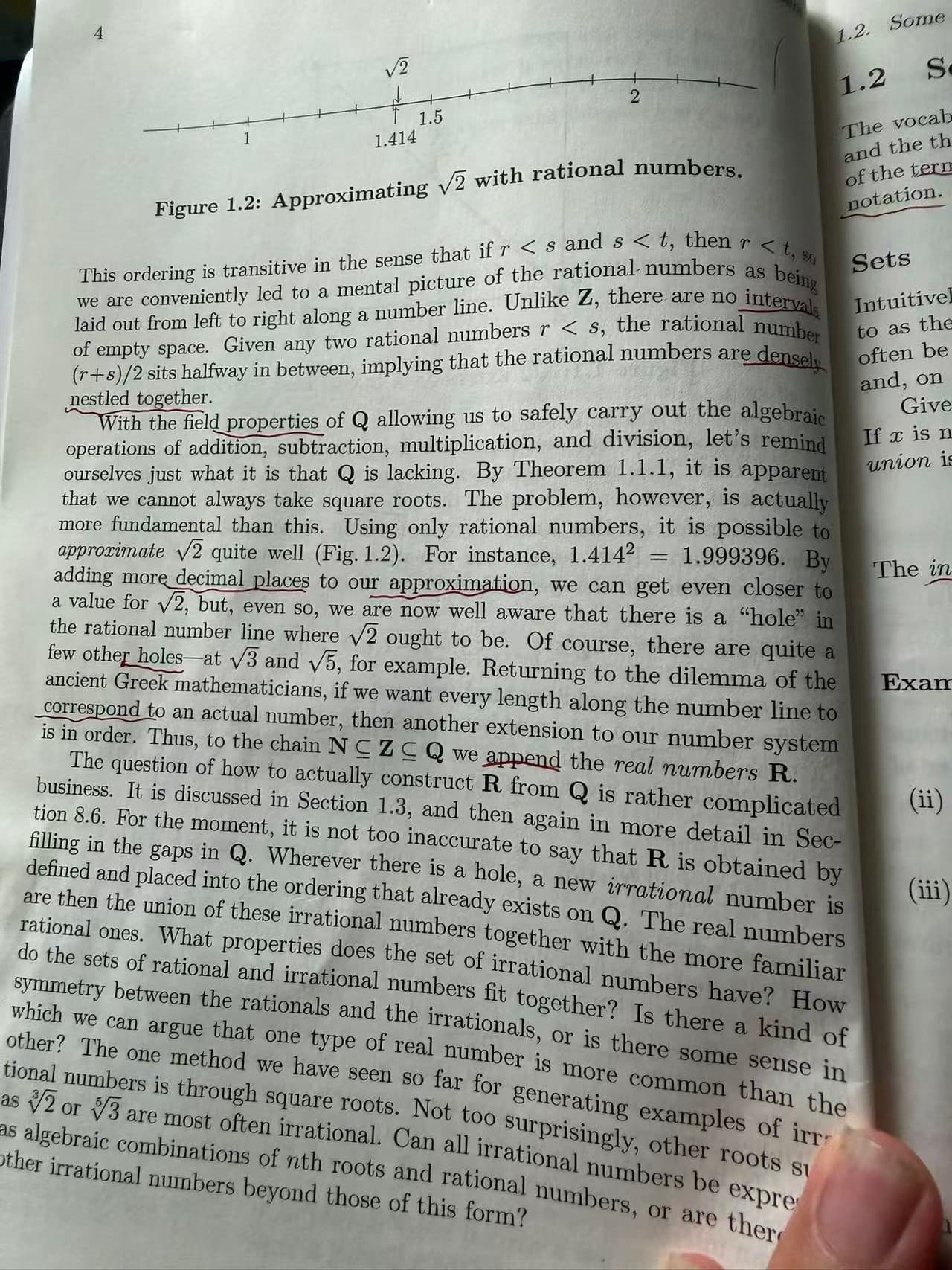
Reconstructing the proof that √2 is irrational
Suppose, for a contradiction, that √2 is rational. We could then write
√2 = p / q, where p and q are relatively prime positive integers.
Squaring gives p² = 2q². Thus p² is even, so p must be even as well. Write p = 2k. Substitution gives q² = 2k², which means q is also even.
But then p and q share a factor of 2, contradicting our choice of relatively prime integers. The assumption that √2 is rational must therefore be false.
I can currently retrace the main steps of this argument. I still need practice deciding what to assume when facing a new proposition, and identifying exactly which definition or premise a contradiction violates.
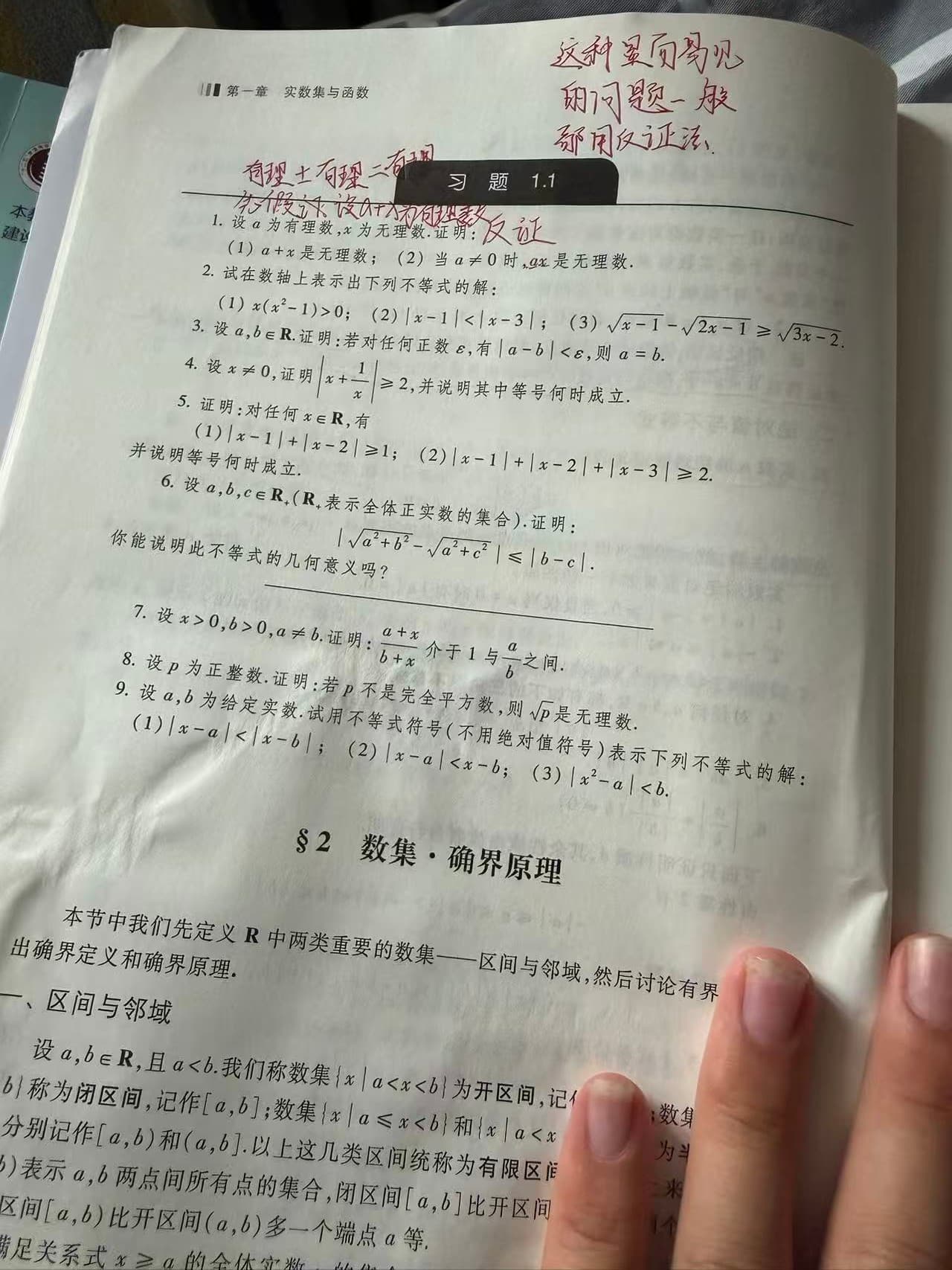
Reading across two languages
Alongside the English text, I have been consulting a Chinese textbook to compare terminology and proof steps. Absolute value, the triangle inequality, and the order properties of the real numbers all matter for what comes next. For now, my work consists mainly of identifying definitions, marking important passages, and following the arguments. I have not yet connected all of this into a coherent understanding.
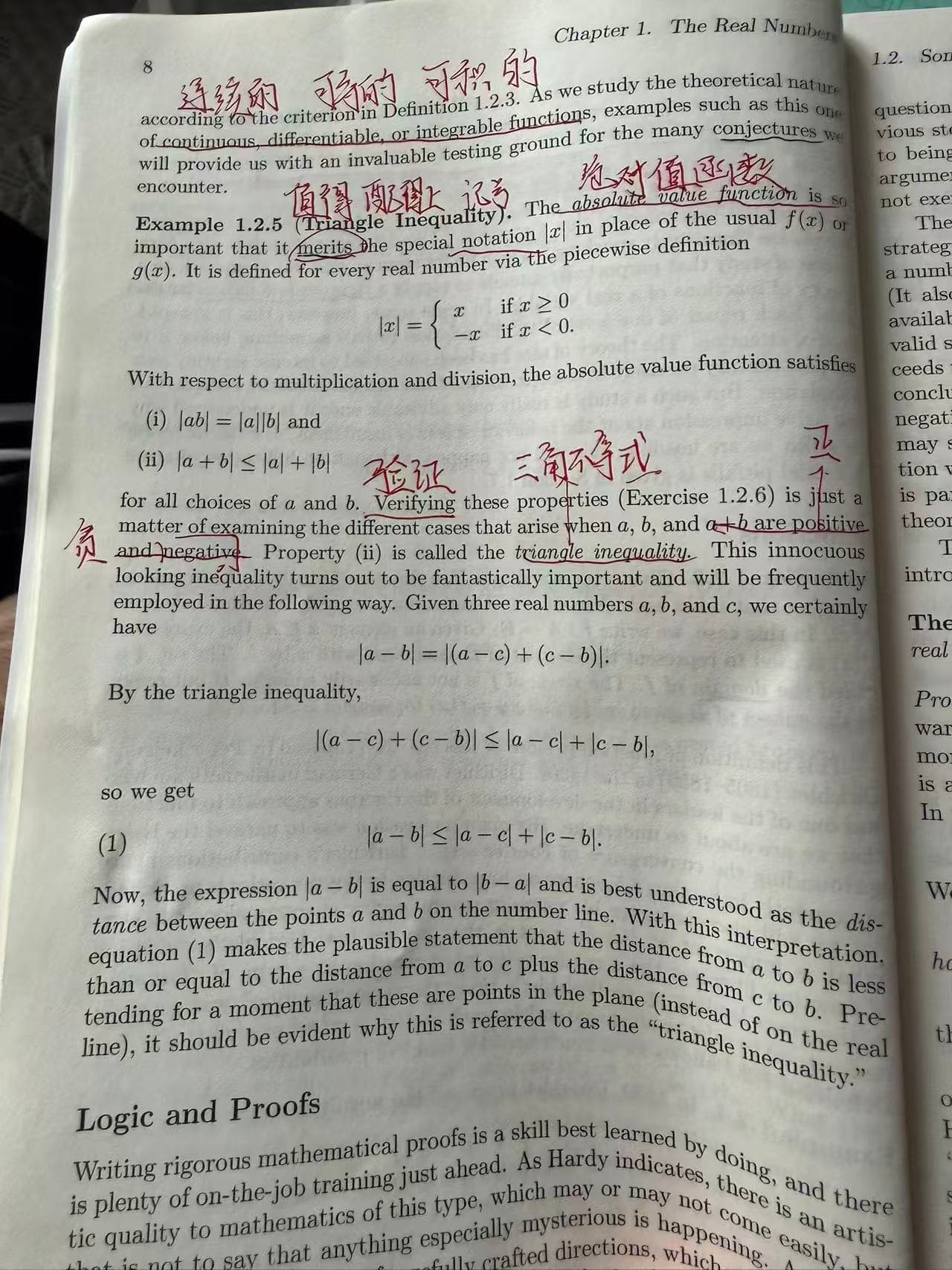
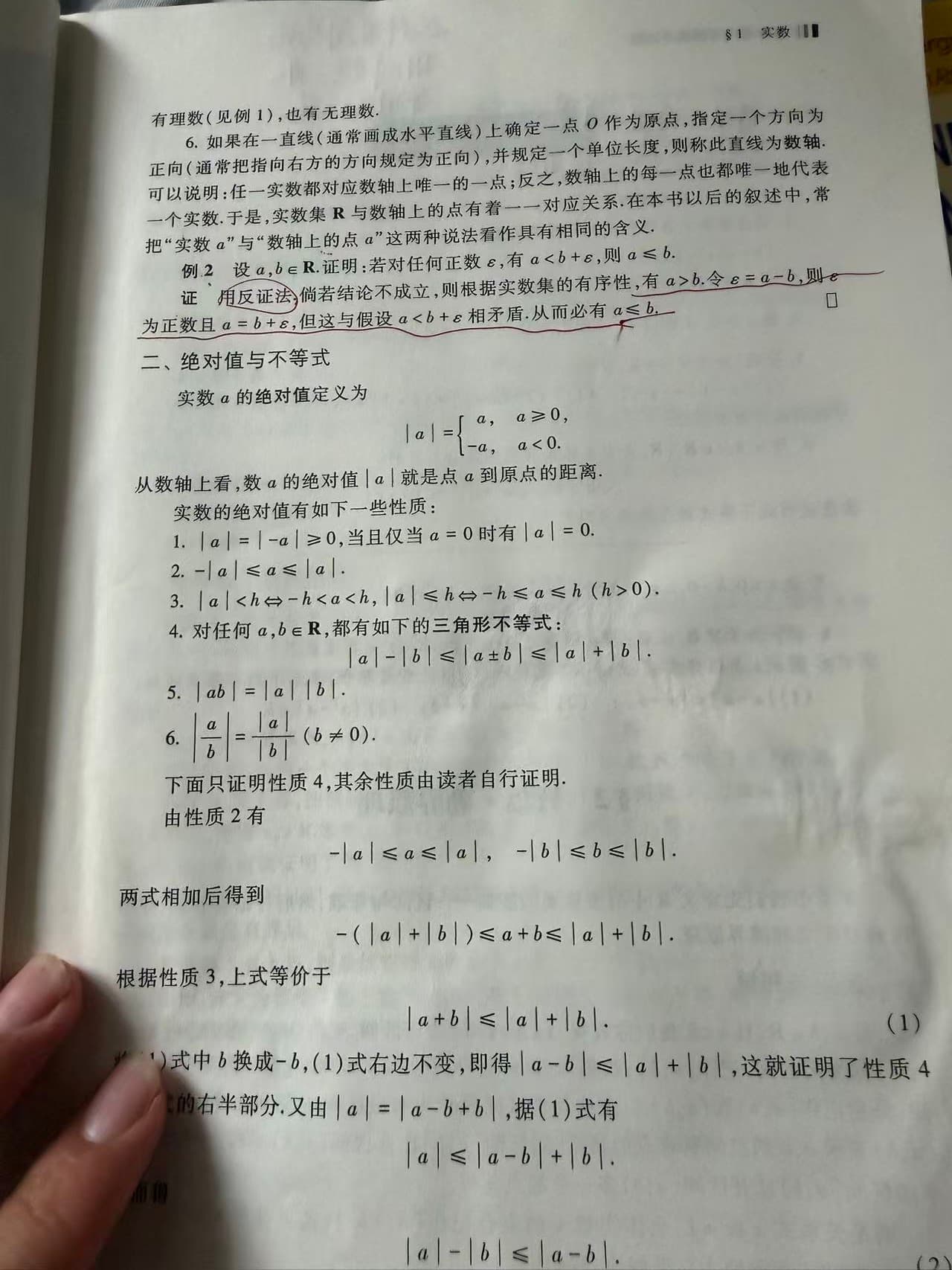
A working analysis glossary
To keep unfamiliar English terms from interrupting every paragraph, I have started a Chinese–English glossary. It includes terms from Sections 1.1 and 1.2 of Understanding Analysis, common phrases used in proofs, and a quick reference for number-system notation.
I will keep revising it as I read. Its purpose is to help me recognize words in their mathematical context; it cannot replace understanding the definitions themselves.
Study resource / PDF · Chinese–EnglishMathematical Analysis GlossaryNotes from Abbott's Understanding Analysis and an ECNU mathematical analysis textbookDownload PDF →Three things need attention: I have not written enough Python on my own, I too easily mistake following a proof for being able to produce one, and I did not review promptly after travelling. My next steps are deliberately limited: revisit Python fundamentals and keep runnable exercises, then rewrite the proof of the irrationality of √2 and work on related proofs and inequalities.
The main lesson from this small stretch of studying is practical. I need to return to ideas, test them, and write them out. Before moving to harder material, I want the concepts I have already encountered to become more dependable.
Comments
0 comments