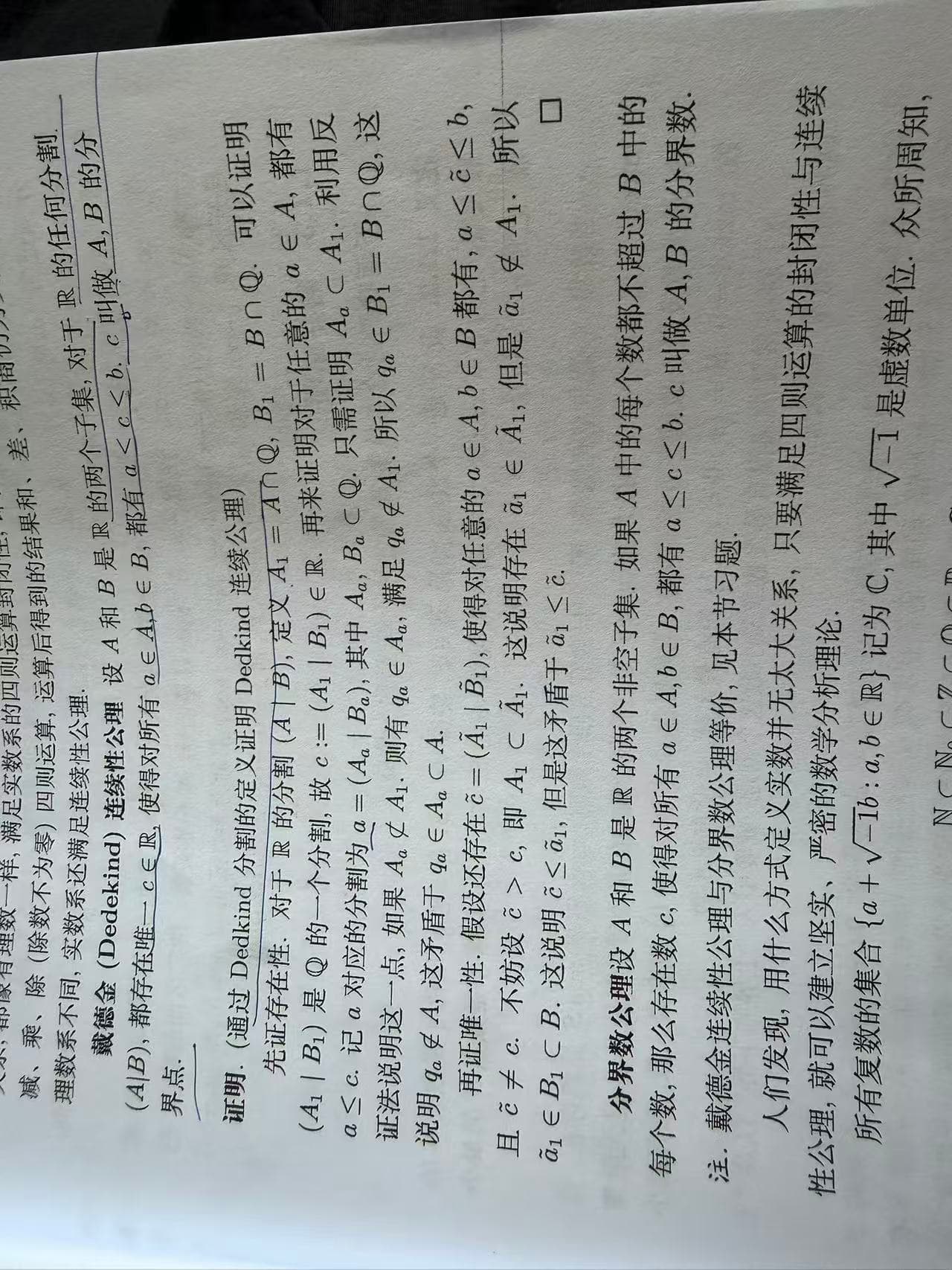
Yesterday I reached the Dedekind continuity axiom in my university's mathematical analysis text and spent nearly forty minutes stuck on the claim that the boundary number is unique. The symbols seemed to circle through one set after another. I still cannot say that I fully understand the proof, so for now I am recording the part of its structure that I can follow.

Separating existence from uniqueness
As I currently understand it, a Dedekind partition divides the real numbers into two nonempty sets A and B. They are disjoint, their union is all of the real numbers, and every member of A is no greater than every member of B.
If a real number c satisfies a ≤ c ≤ b for every a ∈ A and b ∈ B, then c is a boundary number of the partition. Continuity addresses whether such a c exists; uniqueness asks whether two different values could both work. I had been trying to process those questions at the same time, which made the proof harder to untangle.
Seeing uniqueness through a midpoint
For now, I can understand uniqueness through a more direct contradiction argument.
- Suppose one partition has two different boundary numbers, with
c₁ < c₂. - Take their midpoint,
m = (c₁ + c₂) / 2, so thatc₁ < m < c₂. - Because
AandBtogether contain every real number,mmust belong to eitherAorB. - If
m ∈ A, the boundary property ofc₁requiresm ≤ c₁, contradictingm > c₁. - If
m ∈ B, the boundary property ofc₂requiresc₂ ≤ m, contradictingm < c₂.
Both possibilities lead to contradictions, so two distinct boundary numbers cannot exist. The useful part for me is not memorising a long chain of notation. It is recognising the pattern: assume two boundaries, choose a number between them, exhaust the two sets it could belong to, and obtain a contradiction in either case. I still need to check the textbook's version line by line, but at least I now know what to look for.
%, !=, and == in Python
After becoming tired of analysis, I reviewed a little Python. To test whether one integer is divisible by another, I can ask whether the remainder is zero: dividend % divisor == 0.
%is the modulo operator; here it gives the remainder.==compares two values for equality.!=compares them for inequality.=performs assignment and is not interchangeable with==.
The divisor must also be checked before the modulo operation, because division or modulo by zero raises an error.
dividend = int(input('Enter the dividend: '))
divisor = int(input('Enter the divisor: '))

if divisor != 0:
    if dividend % divisor == 0:
        print('Divisible')
    else:
        print('Not divisible')
else:
    print('The divisor cannot be zero')
When I return to the proof, I want to label each line as assumption, midpoint, case, or contradiction, then explain it once without looking at the answer. For Python, I need to run several pairs of integers until %, ==, and != no longer blur together.
I will head back to the library in a while. Enough for today.
Comments
0 comments