I went to the library today to review Python with Heima Programmer's course and revisit my mathematical analysis glossary. Most of the session was spent recovering my bearings with familiar material. By the time I was ready to leave, three hours had passed.

Types, strings, and a small distinction worth keeping
I revisited int, float, and str: integers, floating-point numbers, and text. These are elementary concepts, but after some time away I still need to check my memory against actual code.
The course also covered triple quotes. Introductory lessons sometimes describe an unassigned triple-quoted string as a “multiline comment.” More precisely, '''...''' and """...""" delimit string literals, which can span several lines. A string placed at the beginning of a module, function, or class can serve as its docstring. Ordinary comments use #.
# An ordinary comment

def example():
    """This is the function's docstring."""
It is a small distinction, but one I would rather get right now. Remembering that triple quotes allow several lines is less useful than understanding whether I am looking at a string, a docstring, or a comment.
Revising the analysis glossary
I also added and checked terms in my analysis glossary. The previous version was incomplete. This one is more useful, although it remains a working document that will change as I continue reading Understanding Analysis.
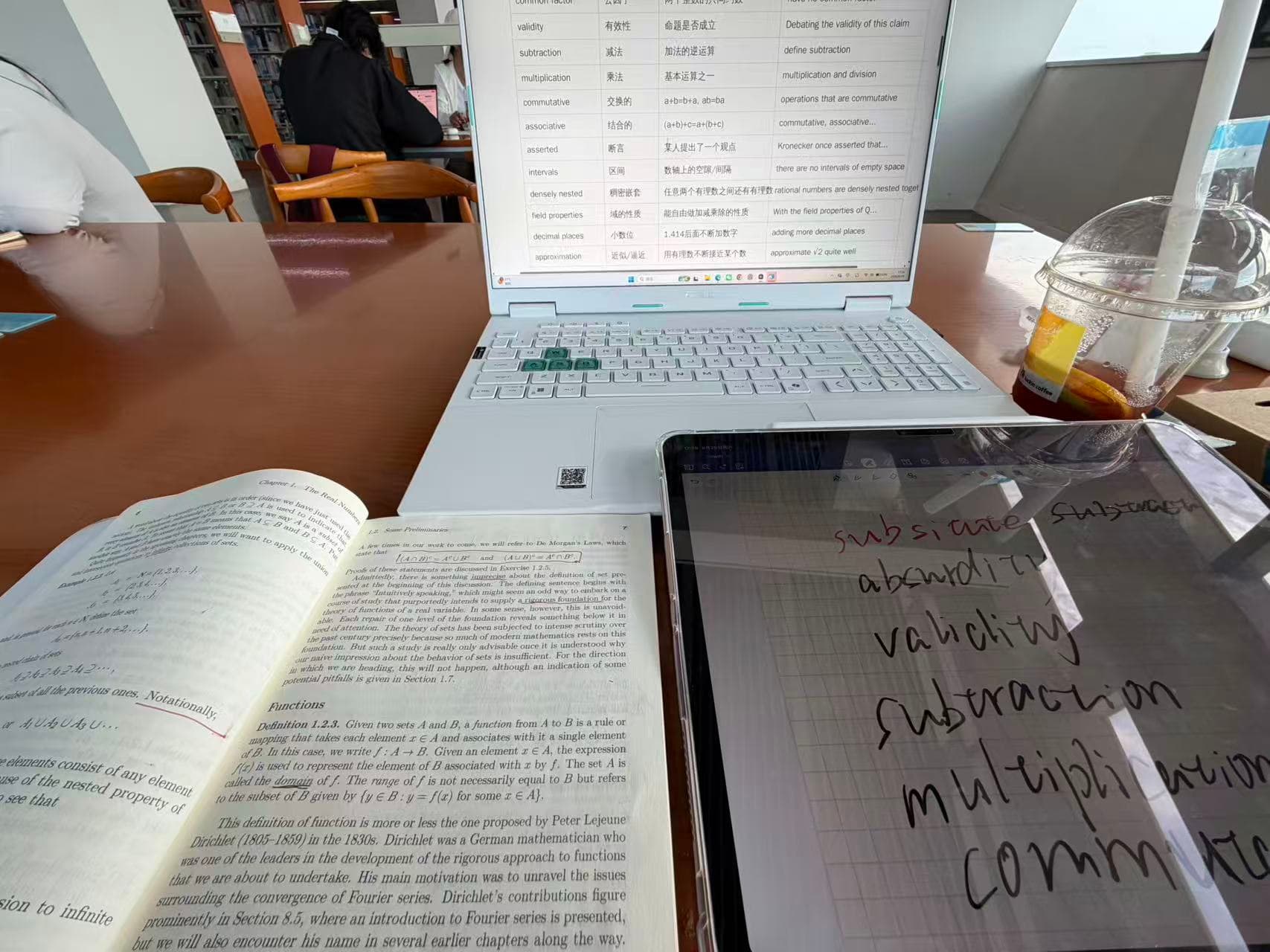
The updated PDF collects the terms I have recorded from Sections 1.1 and 1.2, phrases commonly used in proofs, and number-system notation. It is a Chinese–English study aid, not an exhaustive reference.
Study resource / PDF · Chinese–EnglishMathematical Analysis Glossary3 pages · terminology, proof-writing phrases, and notationDownload PDF →What the three hours tell me
Looking back, I did not cover very much. I kept moving between the lesson, the code, and the glossary, and my attention was divided. That is more useful to record than simply calling myself slow: time at a desk needs to be connected to a clear task.
It is 10:46 p.m. as I write this. That is enough for today.
Good night.
Comments
0 comments